
- News
- City News
- gurgaon News
- 17th-century tomb makes its time bubble in busy Palwal
Trending
This story is from July 23, 2023
17th-century tomb makes its time bubble in busy Palwal
The town of Palwal, 63 kilometres from Gurgaon, played a small but significant part in the country’s mighty struggle for Independence.
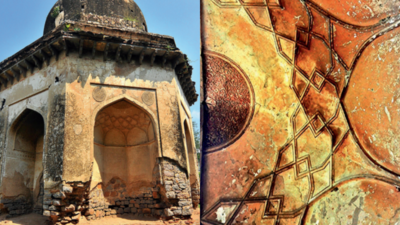
The geometric designs on the monument’s walls and ceilings — both intricate and strikingly unadorned — are still visible.
It was at the railway station here that MK Gandhi, on his way to Punjab to protest against the draconian Rowlatt Act, was arrested.
Gandhi’s call for a nation wide hartal marked his entry into the movement for freedom, that turning point when an irresistible force met an immovable object.

It is located not too far from the station, in the Gandhi Ashram Colony on the old Delhi-Agra highway. That aside, and the fact that the eponymous district is the hub of the cotton trade in these parts, there is little to recommend about urban Palwal, which today falls under the National Capital Region. But this is India, a land where history is in lockstep with the present (often disturbingly so).
Indeed, a couple of Muslim-era buildings also form part of the city’s unremarkable architectural heritage. But it takes an effort to find them. We tried looking for one of red sandstone but came upon the other, a protected monument dating back, according to the ASI, to the 17th century.
And like many such structures, it has seen better days, the burnt clay bricks in its lower half — known as Lakhauri, and widely used during the Mughal period — lying exposed, the plasterwork further up peeling away, the dome looking its age.
Yet, it continues to stand solitary, proud and occasionally magnificent, the geometric designs on the walls and ceilings — both intricate and strikingly unadorned — still visible, and even the calligraphy still discernable despite the dust, rain and pollution of three centuries. Meanwhile, a series of steep steps (not for the vertigo-inclined) takes you to the top, for a more elevated view.
Some accounts say it is the tomb of one Sheikh Shah Baz, who seems to have been lost to time. But whatever the circumstances of its construction, at least this octagonal edifice, with an arch on each of its four sides, is away from any industrial activity, set as it is in a municipal park in Palwal’s Housing Board Colony, overlooking a children’s playground and surrounded by homes.
It is, in fact, a restful spot, the trees standing sentry and birdcalls breaking the late afternoon quietude. And it has a caretaker, though one with only the most basic understanding of its origins. As for the other tomb, where lies buried a saint called Roshan Chirag, its mention brought a blank to the faces of most of those when asked for its whereabouts.
Some had a faint idea that such a building existed in Palwal but were stumped as to where it might be sited. It proved a futile search though after one-and-a-half hours of diligent detective work, another remnant of the past revealed itself. Not surprisingly, it was a city elder who guided us in the right direction. It’s much the same wherever you may be in India.
Serendipity wins the day because there is little desire or determination to document the thousands of buildings that lie unattended and forgotten around us, sometimes out of sight, at others hidden within our neighbourhoods. Residents here know this one endures, just like they know the sun rises in the east and sets in the west. For all that its backstory has vanished, this Palwal gumbad has become part of the domestic scenery, a thought to assure them that all is well with their lives.
End of Article
FOLLOW US ON SOCIAL MEDIA










Photostories

Hot Picks
TOP TRENDING
Popular Categories
Hot on the Web
Top Trends
IND vs AUS Live ScoreBaba Siddique NewsVirat KohliRussell WilsonsSpacex StarshipBabar AzamWho was Baba SiddiqueBabar AzamNTA SWAYAM July RegistrationLawrence BishnoiAmazon LayoffsTaylor SwiftManagement Colleges of IndiaTop Medical Colleges of IndiaTop Engineering Colleges of IndiaTop Pharmacy Colleges of IndiaLive Cricket Score
Trending Topics
Diwali WishesDussehra 2024 QuotesDussehra WishesVettaiyan OTT ReleaseVettaiyan CollectionVettaiyan ReviewNatasa StankovicDevara CollectionBigg Boss 18Deepika PadukoneShraddha KapoorRatan Tata Passed AwayJigra Movie ReviewVettaiyan Movie ReviewSwatantrya Veer SavarkarDussehra 2024Star Health Hacker DemandedViral MemesUltimate Football Codes October 2024Wordle Answer
Living and entertainment
Latest News
Accused did recce of Baba Siddiqui's house, monitored him for months: Mumbai PoliceParas Mhambrey joins Mumbai Indians as bowling coachSalman Khan’s security beefed up after Baba Siddiqui’s murder; ‘Sultan’ star looked uncomfortable after visiting the late politician’s family at 3 amBaba Siddique may have died prior to hospitalisation, says doctorsSpaceX's fifth Starship test flight achieves historic booster catchKrushna Abhishek shares a heartwarming post for mama Govinda; says 'jab body mein adha blood supremely talented actor Govinda ka ho...'News brief: 'Who is listening? Modi?': Kapil Sibal takes a dig at RSS chief Mohan BhagwatZodiac signs likely to have soul connectionsAI’S Oppenheimer'Points towards failure of CM': Sanjay Raut slams Maharashtra govt over Baba Siddiqui's killingMahela Jayawardene returns as Mumbai Indians head coachMidnight queues, long waits, bad advice: It's not easy getting therapy in IndiaTom Brady is Likely to Become a Minority Owner of Las Vegas Raiders at the Upcoming NFL Fall Owners' Meeting4.2 magnitude earthquake strikes AssamThe Great Indian Kapil Show 2: Kareena Kapoor reveals hubby Saif Ali Khan is jealous of her bond with sister Karisma; says, “He thinks I talk to her more than him”Accused were paid in advance to kill Baba Siddique: Mumbai PoliceMammograms and breast cancer treatment: Separating facts from mythsHow vitamin C-rich foods help with weight loss
Copyright © 2024 Bennett, Coleman & Co. Ltd. All rights reserved. For reprint rights: Times Syndication Service